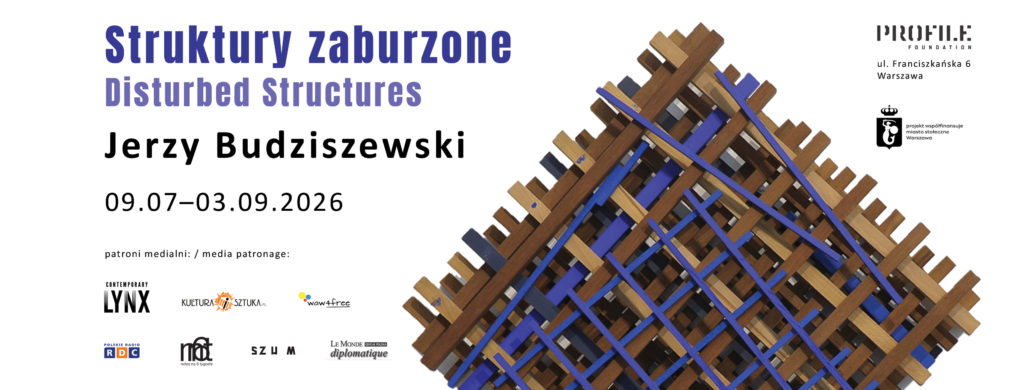
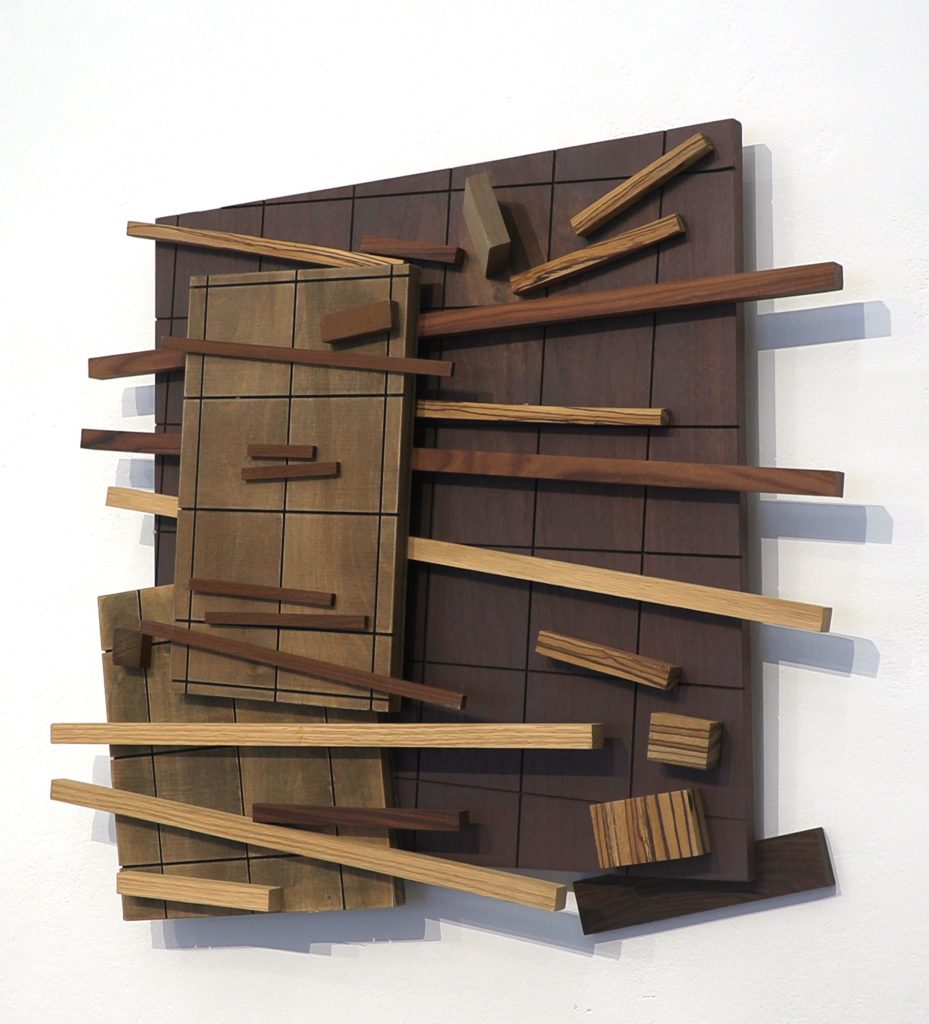
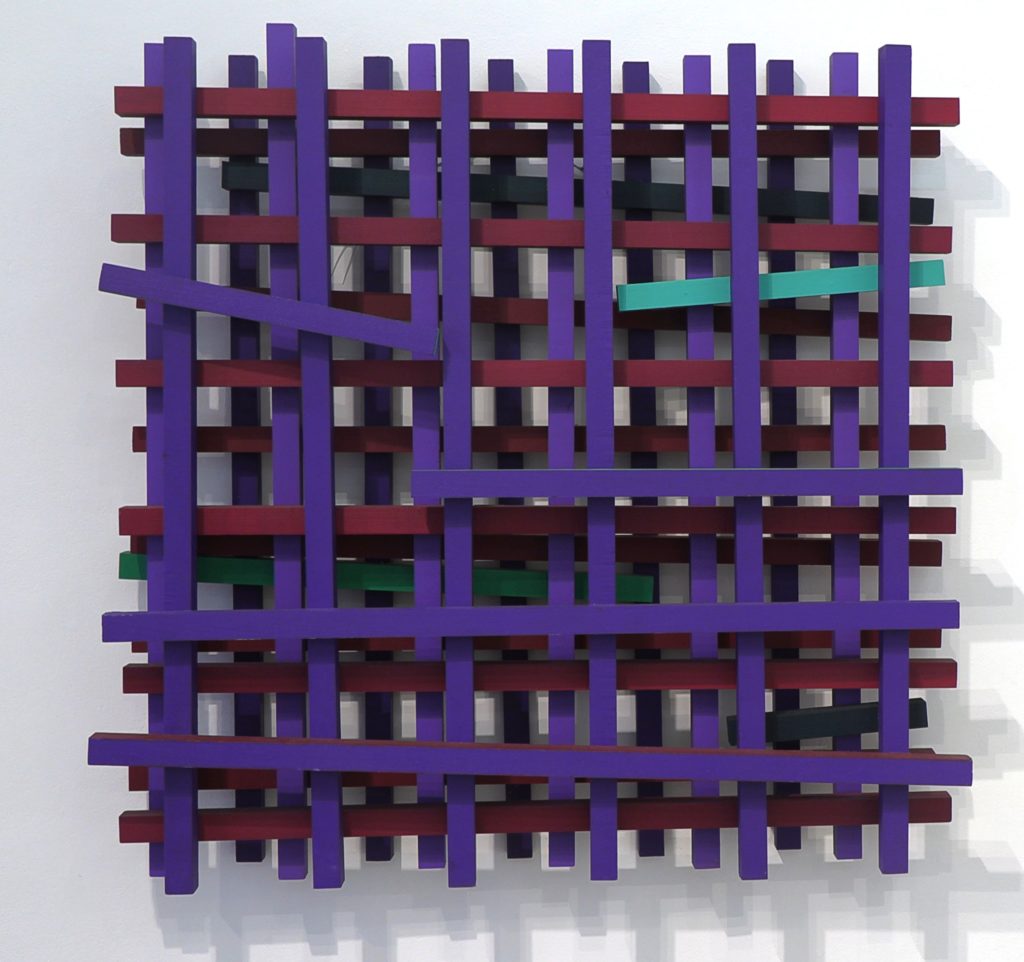
The works of Jerzy Budziszewski are difficult to call paintings, they are rather spatial constructions. And the organization of space seems to be a key category in his artistic practice. Works built from multilayered arrangements of geometric forms create constructions that generate space within and around them. The module of geometric shapes in paintings – and later three-dimensional forms in spatial constructions – also refers to the grid motif. Toward the end of the 1970s in the relief and collage-based monochromatic compositions, the geometric grid module becomes a ‘skeleton’ organizing the field of the picture. At the same time, the logic of the grid’s infinity invisibly leads the gaze beyond the frame of the picture. In spatial forms, in turn, wooden and often irregular trusses, layering one upon another, extend into space through elements that protrude freely from various sides. Their expanding forms create multidimensional constructions that gain dynamics due to various shifts, diagonally placed elements, and oblique arrangements. The disturbances to the statics of the vertical-horizontal divisions introduce a sense of movement, of the spatial dynamics of geometric forms.
Henryk Stażewski wrote in 1982 about the impression of movement evoked by Budziszewski’s works: ‘The novelty of these paintings lies in the fact that the author’s imagination has created a principle that causes the most clear effect of the viewer’s sense of movement.’ The words of the doyen of the avant-garde referred to a series of white paintings, in which identical but obliquely positioned square shapes were placed over static white squares.
The artist was undoubtedly remained under the influence of the Constructivist tradition. On the one hand, the reference was the continuity of this tradition in Stażewski’s work, with whom he maintained a friendly relationship. On the other hand, there was a fascination with Kazimir Malevich’s artistic concepts, and it was not only about ‘reaching whiteness’ (White on white) and the continuum of spatial infinity, but above all, as Andrzej Turowski wrote, about ‘treating spatial constructions as an architectural experience.’ For the creator of Suprematism, his Architectons, spatial objects from the 1920s, were prototypes of architectural forms.
From the very beginning, Budziszewski worked in painting, sculpture, and mural painting; he was the author of several painterly realizations within architectural space. In the 1990s a series of spatial objects emerged, made of wood and cast in bronze. In their constructions of geometric solids, what draws attention is their mutual relations, spatial connections, the orientation and dynamics of the forms in space, their points of contact, their adherence, interpenetration, shifts, and a kind of overhanging of certain forms. Despite their geometry, the artist does not rationalize the experience of space within them; there is no ‘harmony of complementary verticals and horizontals’ in them. Just as in the relief compositions, the various shifts and spatial disturbances deprive the eye of any possibility of static anchoring and static perception. The spatial constructions are, in their own way, disturbed structures. The Constructivist tradition is reworked here already beyond its utopia, just as the grid — which remains a symbol of modernist ambitions — reveals its schizophrenic dimension.
Jerzy Budziszewski (Joshua Ben-Or) was a painter, photographer, and sculptor. He graduated from the Academy of Fine Arts in Warsaw in the painting studio of Prof. Stefan Gierowski in 1975. He exhibited from 1971, including at the Contemporary Gallery and the Galeria Zapiecek in Warsaw. In the early 1970s, he collaborated with Marian Bogusz. He later moved in the circle of artists associated with the artists of the Foksal Gallery and was a friend of Henryk Stażewski. He created several mural compositions, including one as part of the “Open Gallery” on the façade of a tenement house on the Market Square in Krapkowice. During martial law, he organized painting shows in his apartment. Fascinated by Jewish culture, he photographed Jewish cemeteries and synagogues. He published the photographic album, ‘Żywym I umarłym’ (1988), having a year earlier organized a joint exhibition with Tadeusz Rolke under the same title. In 1988, he emigrated to Israel. In 1994, he moved to the United States and settled in New York. He died in Paris in 2006.
The artist’s works are held, among others, in: the National Museum in Warsaw; the National Museum in Krakow; the National Museum in Poznań; the National Museum in Gdańsk; the Museum of Architecture, Wrocław; Moderna Museet, Stockholm; the Museum of Modern Art, Gothenburg; the Guggenheim Museum, New York; the Jewish Museum, New York; and the Ludwig Museum, Cologne.